Showing posts with label hand stitched. Show all posts
Tuesday, 27 March 2012
Textile and Industrial Heritage - Peacock's Shop
I've been challenged to find an embroidery on the Tapestry to link with the Exhibition currently on show at Temple Newsam. This bedstead for 18/9 (that's about 94 pence in "new money") hardly compares with the magnificent, newly reinstated, Queen Anne State Bed but if you visit the present exhibition there are some more lowly servants beds displayed, with interpretation panels, around the House.
It's apparently National Bed Month and to celebrate this:
Bedtime Stories: Temple Newsam is celebrating National Bed Month by having a special talk every Wednesday
Weds, 28th March (11am to 12pm)
Come along and find out about historical beds and bedrooms with stories about the beds at Temple Newsam House, including the Queen Anne State bed. Booking is recommended, contact (0113) 264 7321.
There doesn't seem to be much information on the web about the forthcoming events of Temple Newsam's Bedfest but Textile Hunter has gleaned more about it than any other.
Back to the story of Peacock's. Founded in 1849, Peacock's shop was on the corner of the Headrow and Park Row until 1977, when it moved to its factory site at Kirkstall Bridge Mills. In 1981 the firm were taken over by Durastic Ltd.
Mary Mawson, who hand stitched this piece, was employed in the curtain workshop of the firm for 26 years.
Monday, 26 March 2012
Transport - Eades Reversible Car No. 58
This is from a photograph taken in about 1890 of the Eades Reversible Car No. 58 at Headingley terminus. Three of these trams were supplied to Leeds but were never popular due to the narrowness of the roads at the tram termini. At Chapeltown terminus the car overhung the pavement by over 5 feet when being turned and accidents were not uncommon. Seating was stated to be 18 inside and 20 outside upstairs.
Leeds Transport Historical Society has published several volumes on the subject. Volume 1 written by J Soper covers the period 1830 to 1902 and is a must for anyone wanting to read further.
The embroidery was hand stitched by Eileen Wilson whose husband did a lot of the research for the Transport panel.
Monday, 19 March 2012
Community Spirit - Rob Bumby
A very short post today. Rob Bumby was also involved in Common Purpose.
He was also hand and machine stitched on printed fabric (Three and a half hours).
Saturday, 17 March 2012
Community Spirit - Jane Hustwitt
The embroidery was machine and hand stitched on printed fabric by Janet Taylor. The observant will realise that below the knees the piece is untouched. The lower legs are hidden on the Community Spirit panel and embroidering them, and other covered pieces would have made the final result too bulky.
Wednesday, 14 March 2012
Textile and Industrial Heritage - Marks and Spencer
Apologies for the lack of blogging for the last few months. I've finally found the passwords in an old diary.
Marks and Spencer is the feature today, for the last year or so we've been aware that the firm were having a purpose built archive in Leeds and on Friday of this week (March 16th) it will be open to the public for the first time. It's handily situated on the old Grammar School site at the University of Leeds so both M&S and Ulita (University of Leeds Textile Archive held in the former Grammar School Chapel) can be visited in one outing. Leeds is finally getting textile archives which reflect the history of the City.
Michael Marks(1863-1909) was born in Bialystock in Poland and came to England in 1882. Looking for Barran's works he stumbled into Dewhirst's wholesale factory, borrowed £5 and used it to buy goods to sell as a pedlar. In 1884 he opened a stall in Kirkgate Market where his catch phrase became "Don't ask the price; its a penny". By 1890 he had 5 of these Penny Bazaars in Leeds, Castleford, Wakefield, Warrington and Birkenhead and was looking for a partner to help with the expansion. Thomas Spencer (1888-1964), the cashier and book keeper for Dewhirsts was recommended and they formed the partnership in 1894. By 1905 together they had opened 70 bazaars
The embroidery was hand stitched by Joan Holah on printed fabric.
Wednesday, 16 February 2011
Education - Leeds Civic Trust
The Director of the Trust, Dr Kevin Grady is giving a series of "Leeds in Your Lunch-Hour" talks each Wednesday in February. I apologise for not mentioning these before but there's still time to get to next week's at Holy Trinity Church, on the subject of Lost C18 & C19 Churches and Chapels in the City Centre.
Minnie Woodward spent 62 hours hand stitching this piece on printed fabric.
Thursday, 23 September 2010
Arts for All - Town Hall

On the Arts for All panel there's an embroidery of the interior of the Victoria Hall, within the Town Hall, hand stitched by Gill Cooke.
'Directly influenced by Liverpool's St George's Hall and indirectly by the Baths of Caracalla, the basilican form is expressed by coupled Corinthian columns and pilasters separating the bays'
Brodrick also designed the original ten cut glass chandeliers but only three survive and are now in the Civic Hall. The current lights were installed in the 1930s. The organ was the largest ever built by an English firm, at the time, with 6,500 pipes. Henry Smart and William Spark designed it, Gray and Davison (a London firm) built it and the architectural case was designed by Brodrick.
It must have been spectacular for the people of Leeds in the nineteenth century. Reminds me of the Great Exhibition scene in 'North and South'.
Information for this piece from Susan Wrathmell's Pevsner Architectural Guide of Leeds.
Sunday, 19 September 2010
Arts for All - Old Museum
The original museum in Leeds was in Park Row, designed by Robert Dennis Chantrell in 1821. During World War Two it suffered extensive damage during an air raid. The building was repaired and continued to house the museum until 1965, when it was moved to the Central Library.
From 1999 until 2008 Leeds has been without its museum, but now many of the old favourites are back on show. The museum service also includes The Discovery Centre, near the Royal Armouries, where the majority of the Leeds collections not on display can be accessed by appointment.
Renditions in embroidery of both the new and old museum were done by Godfrey Harland, the one above on printed fabric (73 hours)
Labels:
Discovery Centre,
Godfrey Harland,
hand stitched,
Museum
Wednesday, 15 September 2010
Arts for All - Mechanics Institute interior
The Mechanics Institute, one of the buildings designed by Cuthbert Brodrick and opened in 1865.Leeds Mechanics Institute was founded in 1824 or 1825 (sources vary) and was first established in Park Row. A competition was announced for the plans for the new building in 1860, almost at the same time as Brodrick had won the contest for the Corn Exchange.
The plan was centred on a circular lecture room fitted in a rectangular shell which contained workshops, studios and a library.
In the early nineteenth century Mechanics Institutes were founded in many cities of the UK, the first being in Glasgow. They were usually funded by industrialists to provide education for working men, particularly in technical subjects. It has been said that one of the main aims was to steer people away from gambling and alcohol.
Very soon after the opening of the new building, in 1868, Leeds Mechanics Institute became the Leeds Institute of Science, Art and Literature, later renamed Leeds College of Technology, and now within the Metropolitan University. Research has also revealed that in 1903 it joined with the Literary Institute to form Leeds College of Art. That's the internet for you. Back to the books.
The embroidery was hand stitched on printed fabric by Hilary Thurlow.
Tuesday, 14 September 2010
Textile and Industrial Heritage - Cuthbert Brodrick
Cuthbert Brodrick was born in Kingston-upon-Hull in 1821. When he was 15 he became articled to Henry Francis Lockwood, an architect in Hull who was influenced by the classical style. After this he toured Europe to study the major cities, then returned to Hull in 1845 to set up his own practice. When he was 29 he won a competition to design Leeds Town Hall, which building was opened by Queen Victoria in September 1858. He also won the competitions to design the Corn Exchange (opened 1862) and the Mechanics Institute (opened 1865).
Brodrick's fourth public building for Leeds was the municipal baths, opened in 1867 and demolished in 1969. There's a strange photograph of the Alpine Sun Baths over on the Leodis site. A bar, named The Cuthbert Brodrick now stands on the site, overlooking Millennium Square.
The piece was hand stitched by Janet Carding (26 hours), love the beard.
Tuesday, 7 September 2010
Sports for All - Rugby Players
I can't identify the rugby players, they are an embroidered version of a cartoon drawn by one of the pupils at Intake School. Apparently the school closed in 2009 and re-opened as Leeds West Academy.They were hand stitched by Pat Potton.
A very quick posting this morning.
Labels:
hand stitched,
Pat Potton,
Rugby players,
Sports for All panel
Sunday, 5 September 2010
Sports for All - Darren Gough
Several famous cricketers from the past were included in the Tapestry and Darren Gough was there to represent cricketers of the present. He retired at the end of the 2008 season.Despite leaving Yorkshire for a while to play for Essex, he returned to his home county in 2007 to captain the team.
Darren Gough may have been included on the Tapestry for his cricketing skills but since then he has also become quite a celebrity for winning Strictly Come Dancing. In December 2005, he took part in the BBC television show partnered with British National champion Lilia Kopylova. He went on to win both the main series and the 2005 Christmas Special. Two years later he returned to win the 2007 Christmas Special. Following this he took part in the Strictly Come Dancing live tour during January and February 2008.
The piece was hand stitched by Margaret Clark and designed by one of the pupils at Intake High School.
Saturday, 4 September 2010
Sports for All - Headingley Cricket Ground

There are gates at the cricket ground named for Len Hutton.
On 7 March 1861, a Match Fund Committee to run Yorkshire county matches was established in Sheffield, which had by then been the home of Yorkshire cricket for nearly 100 years. It was from this fund that Yorkshire CCC was founded two years later. Yorkshire played their first game at Headingley in 1891 and two years later a major reorganization of the Club saw its centre of operations shift from Sheffield to Leeds.
On 31 December 2005 Yorkshire County Cricket Club purchased the cricket ground for £12 million from the Leeds Cricket, Football and Athletic Company, parent company of the rugby league club, with the help of a £9 million loan from Leeds City Council. This purchase ensures that Test Cricket continues at the venue with a 15-year staging agreement. On 11 January 2006 the stadium was officially renamed the Headingley Carnegie Stadium as a result of sponsorship from Leeds Metropolitan University.
The piece was hand and machine stitched by Janet Taylor (12 hours)
Friday, 3 September 2010
Sports for All - Len Hutton (1916-1990)
Sometimes it can be difficult to think of a subject for the daily blog. There are so many diverse subjects on the Tapestry that a link with the news stories of the day can help. Cricket seems to be featuring heavily at the moment, so not exactly linked to the news story, today's offering is Sir Len Hutton.Born at Fulneck, Pudsey on 23rd June 1916, he first played cricket, with his father, with Fulneck Sunday School and at the age of 13 was chosen to use the ‘nets’ at Headingley. In 1934 he scored the first of 129 centuries for county and country. In 1938, against the Australians at the Oval, he scored 364 runs, a record that stood for many years until Gary Sobers beat it by one run (against Pakistan in 1958). He was awarded his knighthood in the 1956 New Year’s Honour's List.
The embroidery was hand stitched by Merel Jackson (14 hours). I suspect the print was based on a cigarette card owned by Robin Dove.
Monday, 30 August 2010
Community Spirit - Injuns
The sun is shining this morning so fingers crossed, the weather stays dry for the procession.
Sunday, 29 August 2010
Community Spirit - Carnival Queen
Hand stitched on printed fabric by Godfrey Harland (17 hours)
Thursday, 26 August 2010
Community Spirit - Irish Dancer
An Irish dancer. There are many thriving groups and classes for the dance around Yorkshire and there's a website devoted to the subject, including making the dresses. These dresses must take an age to make with the design in embroidery and applique.
So, an embroidery of embroidery, stitched by Jan Brown on printed fabric. Does anyone know who the girl is?
Labels:
Community Spirit panel,
hand stitched,
Irish Dancer,
Jan Brown
Wednesday, 25 August 2010
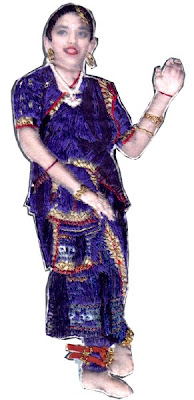
Community Spirit - Orissi Dance
The Orissi dance is the Indian classical dance from the Eastern state of Odissa. It has a long, yet broken tradition. Although dance in Odissa may be traced back more than 2000 years, it was brought to near extinction during the colonial period. Therefore, modern Odissi dance is a reconstruction.
There are taster classes in Leeds to learn some forms of Indian dancing and Zoobin Surty's group often have end of year/term exhibitions at the Yorkshire Dance Centre.
The piece was hand stitched by Thelma Manning (30 hours) on printed fabric.
Labels:
Community Spirit panel,
hand stitched,
Orissa,
Thelma Manning
Tuesday, 24 August 2010
Community Spirit - Bharatanatyam Dancer
On the Community Spirit panel there are several dancers from many parts of the world. The Morris men and Women have been blogged (see 14th May) already.
Today's offering is Bharatanatyam from South India, not just a dance but a variety of natya yoga which reveals the spiritual through the physical and emotional body. It's possibly more enlightening to check out their website than having me getting things wrong.
Margaret Clark hand stitched this piece (39 1/2 hours).
Saturday, 21 August 2010
Education - Leeds Waterfront Heritage Trail
To promote public awareness & enjoyment of the historic waterfront of Leeds the “Leeds Waterfront Tourist Development Action Programme” was established in 1990. This has involved Leeds City Council, British Waterways, Leeds Development Corporation, and the English and Yorkshire Tourist Boards, as well as the National Rivers Authority and the Leeds/ Bradford City Action Team. Leeds City Museum published a pamphlet showing the Heritage Trail in the early 1990s. The trail starts at Rodley Fall in the west and ends about 8 miles later at Thwaite Mill in the east. Between these two points are museums, Kirkstall Abbey, parks, chemical works, tanneries, rhubarb fields, breweries, hotels and many bridges.
Hand stitched on printed fabric by Lesley Dove in 40 hours.
Subscribe to:
Posts (Atom)