Showing posts with label Maureen Carr. Show all posts

Monday, 28 June 2010

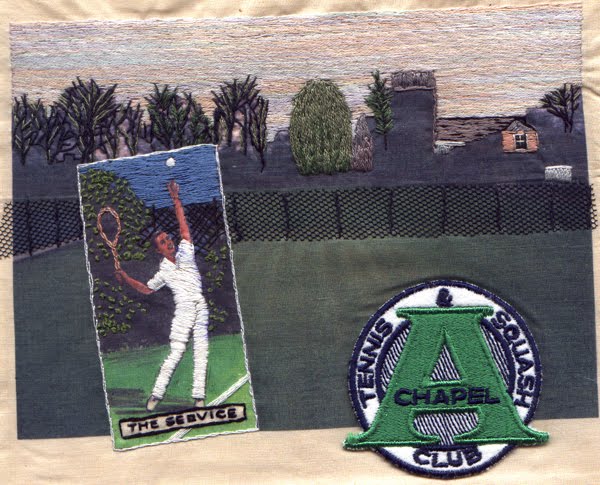
Sports for All - Chapel Allerton Tennis & Squash Club


I wonder if 'the service' embroidered here is another of Robin's cigarette cards?

Chapel Allerton Lawn Tennis Club was formed in 1880 with 17 male members. The club had 5 grass courts and a wooden pavilion. By 1927 the club was the northern venue for the Wimbledon qualifying event. Since then further courts have been added, totalling sixteen, of which 3 are indoor and three have floodlights.

In 1960 the club purchased a wooden squash court from Huddersfield LTC and due to the popularity of the sport the club changed its name to Chapel Allerton Lawn Tennis and Squash Club in 1963. The club now boast 6 courts of which three are glass backed.

In 1986 a gymnasium was added to the facilities and this area of the club now provides a wide range of equipment not just for the racket players but its own fitness members.

Joyce Fulton (now Howden) and Michael Hann, club members in the 1950s both played at Wimbledon. We have a connection.


The piece was hand stitched by Maureen Carr

Monday, 26 April 2010

Textile and Industrial Heritage - James Hare


Having written about Alfred Brown's company (established in 1915) I've now started looking to see if any other companies on the Tapestry have survived with the original families running them. James Hare's is one such, and the family were very generous in providing silk fabric for use on the Tapestry.
James Hare started his apprenticeship in a woollen mill in the mid c19. He then became a woollen and worsted merchant first in a cottage in Clare Street (1865), and then he took a warehouse on Wellington Street. In 1913 the firm began to manufacture cloth at Arlington Mills and then acquired a warehouse on Queen Street and built Coronet House.

In 1973 “Hare of England” were sold to Illingworth Morris of Bradford and the fourth generation of the family have continued in business as “James Hare Silks” one of the largest distributors of silk fabrics.
I'm hoping someone from the company can add information about the change of logo.

Valerie Horner made the logo in goldwork, taking 45 hours in the task. Elizabeth Thackrah assembled the book cover with hand dyed fabrics and with notions supplied by Brian Peace, Margaret Clark and Maureen Carr.
Godfrey Harland hand stitched the building on printed fabric in 29 hours.


PS reply from James Hare that this has always been their logo

Saturday, 17 April 2010

Leeds in Bloom - Oakwood Clock


Designed by Leeming and Leeming and made in 1904 by Potts and Sons of Guildford Street Leeds. The clock was originally the centrepiece of Leeds New Market Hall (1904) but alterations to the building made it obsolete and the decision was made to move it to Oakwood in 1912.

Originally a gravity hand-wound striking clock the mechanism was removed in 1941 (re-used in Leck Church, Lancashire) and a self-starting synchronous movement was fitted, the bell was broken up and used for scrap.

Potts and Sons made many clocks for Leeds including those in Thornton's Arcade (with figures by JW Appleyard), The Griffin Hotel and the clock on the Stable Block in Roundhay Park. Going off the point a bit, there seems to be some confusion in the books about Leeds as to who built the clock in the Grand Arcade - were Robert James and Joseph Potts of Leeds part of the same family and company? For readers wanting more information on Potts there is a flicker group of photographs of the clocks and a book on the history of the firm.

The company joined the Smith of Derby Group in 1933, but possibly still have a base in Leeds? Not any longer - see notes from Michael Potts below.

The canvas was chartered by Ann Wheatley and the piece was started by Maureen Carr and finished by Godfrey Harland (Godfrey spent 199 hours working on it).

Additional notes supplied by Michael S Potts, direct descendant of Robert and William and collector and researcher of clocks made by the Potts Family:

1. The firm's name was Wm. Potts & Sons in 1904 and apart from the addition of "Limited" a few years later it has remained the same to the present day. Robert, James and Joseph were William's sons who joined the firm. In the end five consecutive generations of the family were involved in clockmaking.
2. the Oakwood clock movement is now at Leck Church.
3. The firm installed over a hundred public clocks in Leeds between 1858 and 1934, not all of which have survived, but many have. Thornton's, Queen's, Grand, and Market Arcades all had clocks. Other significant buildings in the city centre that can be seen today are The Corn Exchange (1862), Griffin Hotel (1877), General Post Office (1895), Leeds Parish Church (1898), Holy Trinity Church(1902).
4. The firm joined Smith of Derby in 1934. They no longer have a base in Leeds.

Thank you Michael


Related Posts with Thumbnails