

Monday, 7 May 2012
John Barran on Secret Lives blog


Thursday, 29 March 2012
Textile and Industrial Heritage - Peacock and Sons
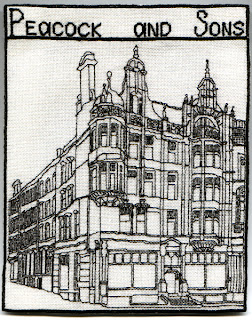
Mary Mawson also stitched the image of Peacock's building. She asked the Peacock family if they would sponsor the pieces on the Textile panel and they were happy to do so.
When we had workshops or 'get togethers' at the Tapestry (first at Kate's home, then Armley Mills and latterly at Holy Trinity) the stitchers would happily talk about their jobs in the textile industry before the 1980s. Mary recalled that the Peacock family treated their employees very fairly. Before the advent of state pensions one man was kept on, well passed retirement, to open the back door. She said that it wasn't really a job, but it gave that person not only a small income but also a purpose.
It's a real pity that we don't have recordings of some of the reminiscences shared while we sat and stitched. I think possibly that there are some videos taken by Antonia Lovelace, Curator of World Culture at Leeds Museums Service, but they were only shot during stitching together the last panel, Arts for All.
The piece was produced using the counted threadwork technique of blackwork and was charted by Hazel Rand.
Tuesday, 27 March 2012
Textile and Industrial Heritage - Peacock's Shop

I've been challenged to find an embroidery on the Tapestry to link with the Exhibition currently on show at Temple Newsam. This bedstead for 18/9 (that's about 94 pence in "new money") hardly compares with the magnificent, newly reinstated, Queen Anne State Bed but if you visit the present exhibition there are some more lowly servants beds displayed, with interpretation panels, around the House.

It's apparently National Bed Month and to celebrate this:
Bedtime Stories: Temple Newsam is celebrating National Bed Month by having a special talk every Wednesday
Weds, 28th March (11am to 12pm)
Come along and find out about historical beds and bedrooms with stories about the beds at Temple Newsam House, including the Queen Anne State bed. Booking is recommended, contact (0113) 264 7321.
There doesn't seem to be much information on the web about the forthcoming events of Temple Newsam's Bedfest but Textile Hunter has gleaned more about it than any other.
Back to the story of Peacock's. Founded in 1849, Peacock's shop was on the corner of the Headrow and Park Row until 1977, when it moved to its factory site at Kirkstall Bridge Mills. In 1981 the firm were taken over by Durastic Ltd.
Mary Mawson, who hand stitched this piece, was employed in the curtain workshop of the firm for 26 years.
Monday, 26 March 2012
Transport - Eades Reversible Car No. 58

This is from a photograph taken in about 1890 of the Eades Reversible Car No. 58 at Headingley terminus. Three of these trams were supplied to Leeds but were never popular due to the narrowness of the roads at the tram termini. At Chapeltown terminus the car overhung the pavement by over 5 feet when being turned and accidents were not uncommon. Seating was stated to be 18 inside and 20 outside upstairs.
Leeds Transport Historical Society has published several volumes on the subject. Volume 1 written by J Soper covers the period 1830 to 1902 and is a must for anyone wanting to read further.
The embroidery was hand stitched by Eileen Wilson whose husband did a lot of the research for the Transport panel.
Monday, 19 March 2012
Community Spirit - Rob Bumby

He was also hand and machine stitched on printed fabric (Three and a half hours).
Saturday, 17 March 2012
Community Spirit - Jane Hustwitt
 Jane was a participant in Common Purpose (see Wednesday's entry).
The embroidery was machine and hand stitched on printed fabric by Janet Taylor. The observant will realise that below the knees the piece is untouched. The lower legs are hidden on the Community Spirit panel and embroidering them, and other covered pieces would have made the final result too bulky.
Thursday, 15 March 2012
Community Spirit - Common Purpose
 Kate and I have just been interviewed by James, a student at Leeds Met, who is writing a piece about the Tapestry on the University web magazine. This reminded me that one of the factors which led to Kate instigating such a huge project was 'Common Purpose'
"Common Purpose is all about finding, encouraging and developing leaders: wherever they are and whatever they are currently doing. To encourage individuals to help to change and improve society (rather than waiting for others to take the lead always)."
A precursor of Mr Cameron's big society.
The embroidered logo is one of the few on the panels which was executed using a domestic computerised sewing machine.
Wednesday, 14 March 2012
Textile and Industrial Heritage - Marks and Spencer

Apologies for the lack of blogging for the last few months. I've finally found the passwords in an old diary.
Marks and Spencer is the feature today, for the last year or so we've been aware that the firm were having a purpose built archive in Leeds and on Friday of this week (March 16th) it will be open to the public for the first time. It's handily situated on the old Grammar School site at the University of Leeds so both M&S and Ulita (University of Leeds Textile Archive held in the former Grammar School Chapel) can be visited in one outing. Leeds is finally getting textile archives which reflect the history of the City.
Michael Marks(1863-1909) was born in Bialystock in Poland and came to England in 1882. Looking for Barran's works he stumbled into Dewhirst's wholesale factory, borrowed £5 and used it to buy goods to sell as a pedlar. In 1884 he opened a stall in Kirkgate Market where his catch phrase became "Don't ask the price; its a penny". By 1890 he had 5 of these Penny Bazaars in Leeds, Castleford, Wakefield, Warrington and Birkenhead and was looking for a partner to help with the expansion. Thomas Spencer (1888-1964), the cashier and book keeper for Dewhirsts was recommended and they formed the partnership in 1894. By 1905 together they had opened 70 bazaars
The embroidery was hand stitched by Joan Holah on printed fabric.
Thursday, 5 May 2011
Faith in the City - Binns Organ

This week only. Lidgett Park Methodist Church is having an open week with a small display of Christening Robes and Wedding Dresses belonging to members of the congregation.
I went along to visit and realise they have one of James Jepson Binn's organs, which had originally been designed and fitted at Eldon Methodist Church in Woodhouse Lane.
Apparently there used to be quite a community of organ builders in Bramley, the most notable being "Battleship Binns". One of his instruments was embroidered by Anne Boyle for the Faith Panel but unfortunately the database doesn't include where this organ is housed.
I quote from the Albert Hall, Nottingham website
James Jepson Binns (1855-1928) was one of the most successful and prolific of the numerous Yorkshire organ builders working at the turn of the 20th century. The firm's most distinguished work was produced between the 1890s and the First World War. Binns was initially apprenticed to the Leeds firm of Radcliffe and Sagar, and from about 1873 to 1880 he worked for Abbott and Smith, latterly as head voicer. He established his Bramley Organ Works in 1880.
For those interested in finding more Binn's organs there's a Wiki site listing locations
Monday, 14 March 2011
Education Panel - Garforth Community College

Another piece worked in Mumbai by Zuber Mohammed and his team, co-ordinated by Ayesha Dost.
The School was formerly known as Garforth Comprehensive School (until 1992) and since the Tapestry was completed has had another name change to Garforth Academy with specialist Arts College status.
Sunday, 13 March 2011
Faith in the City - Medina
In celebration of a rare opportunity to watch an entire programme (Hidden Treasures of India, broadcast on Friday BBC2 at 9.00pm - check out iPlayer) devoted to textiles, this piece, mainly of Aari work is today's offering. In the programme it was suggested that this sort of work is no longer made commercially in Gujarat, but it's certainly still made in Mumbai.

Medina is the second most sacred city of Islam and it is located in the Hijaz Region of Saudi Arabia, 360 km north of Mecca. The Prophet Muhammad began his mission in Mecca in the year 609. After 13 years in Mecca he moved to Medina in order to escape the escalating hostility by the polytheists. The people of Medina welcomed him and presented him with land to build a house and a place of prayer, a mosque. After his death, he was buried in his house which was adjacent to the mosque. In subsequent years due to extension of the mosque his place of burial became enclosed in the mosque. The mosque is now know as 'Masjid-un-Nabi' or the Mosque of the Prophet.
Ayesha Dost took this picture of the Masjid-un-Nabi and other pieces to Mumbai, India, and a number of people embroidered them in traditional Indian stitches. Master craftsmen, whose families have been embroiderers for generations, teach young boys to embroider and this piece will have been done by several young lads at the same time, all working while seated in a circle.

Medina is the second most sacred city of Islam and it is located in the Hijaz Region of Saudi Arabia, 360 km north of Mecca. The Prophet Muhammad began his mission in Mecca in the year 609. After 13 years in Mecca he moved to Medina in order to escape the escalating hostility by the polytheists. The people of Medina welcomed him and presented him with land to build a house and a place of prayer, a mosque. After his death, he was buried in his house which was adjacent to the mosque. In subsequent years due to extension of the mosque his place of burial became enclosed in the mosque. The mosque is now know as 'Masjid-un-Nabi' or the Mosque of the Prophet.
Ayesha Dost took this picture of the Masjid-un-Nabi and other pieces to Mumbai, India, and a number of people embroidered them in traditional Indian stitches. Master craftsmen, whose families have been embroiderers for generations, teach young boys to embroider and this piece will have been done by several young lads at the same time, all working while seated in a circle.
Saturday, 19 February 2011
Leeds in Bloom - Harewood Estate
 It's snowing again in Leeds today, though it looks wet enough not to last. This piece of embroidery was hand and machine stitched on printed fabric by Janet Taylor and comes from a photograph taken on the Harewood Estate.

Needle weaving using a wire framework was the technique used to embroidery these leaves. Those above made by Margaret Foxcroft, and those below by Muriel Gabbitas
Wednesday, 16 February 2011
Education - Leeds Civic Trust
 Leeds Civic Trust was founded in 1965 and is an independent, non political, voluntary organisation made up of people who live or work in Leeds and are keen to promote its improvement.
The Director of the Trust, Dr Kevin Grady is giving a series of "Leeds in Your Lunch-Hour" talks each Wednesday in February. I apologise for not mentioning these before but there's still time to get to next week's at Holy Trinity Church, on the subject of Lost C18 & C19 Churches and Chapels in the City Centre.
Minnie Woodward spent 62 hours hand stitching this piece on printed fabric.
Thursday, 28 October 2010
Textile and Industrial Heritage - Madeira Threads
 ....and here's a selection of the threads sold at MKC, though in drawers of 1000m spools rather than the smaller quantities.
Madeira is a third generation company established in 1908 in Freiburg, Germany. In 1983 Ian and Sara MacPherson set up Madeira Threads (UK) Ltd with Ulrich and Michael Schmidt, grandsons of the original founders, to meet the growing demands for Madeira threads in the UK. They worked from home at first and in 1988 moved to purpose built premises in Thirsk.
Ian and Sara retired in 2001 and Madeira UK is now headed by Karen Burrows, Managing Director, and Clare Walsh, Company Secretary, who have been with Madeira for 17 and 16 years respectively.
Ann Kirk spent at least as much time tracking down the right coloured threads as actually hand stitching the embroidery.
Wednesday, 27 October 2010
Textile and Industrial Heritage - MKC & The Bernina Club
 Normal Service can now be resumed.
As many of you may know, MKC has moved from Kirkgate. Originally the rumours were that the owners were retiring and the business would be closed. Then I heard from a friend that some of the staff were re-opening in new premises near The Calls. I finally made the effort to find the new shop yesterday.
Sheila Udakis (who embroidered the piece above on a computerized machine) and Roy are now operating as MKC (Services), Unit 8, 30-38 Dock Street. Simple to find with parking for those who need it, turn left to the left of The Adelphi.
Still the best choice of Madeira machine embroidery threads in Leeds and suppliers and repairers of sewing machines. Phew.
Thursday, 23 September 2010
Arts for All - Town Hall

On the Arts for All panel there's an embroidery of the interior of the Victoria Hall, within the Town Hall, hand stitched by Gill Cooke.
'Directly influenced by Liverpool's St George's Hall and indirectly by the Baths of Caracalla, the basilican form is expressed by coupled Corinthian columns and pilasters separating the bays'
Brodrick also designed the original ten cut glass chandeliers but only three survive and are now in the Civic Hall. The current lights were installed in the 1930s. The organ was the largest ever built by an English firm, at the time, with 6,500 pipes. Henry Smart and William Spark designed it, Gray and Davison (a London firm) built it and the architectural case was designed by Brodrick.
It must have been spectacular for the people of Leeds in the nineteenth century. Reminds me of the Great Exhibition scene in 'North and South'.
Information for this piece from Susan Wrathmell's Pevsner Architectural Guide of Leeds.
Wednesday, 22 September 2010
Enterprise Panel - Town Hall
 Back with Cuthbert Brodrick, his Town Hall is on the Enterprise panel. This was one of the first four panels, completed before we had the technology to scan each of the embroideries before they were stitched to the background. Hopefully the four will be taken out of their frames to get more detailed photographs which could be posted on the blog.
The Town Hall in the night sky was made in applique by Sue Hodgson. This corner of the panel represents the Valentine Fair which used to be held around the Headrow and City Library.
Quoting Building News in 1858 'Profuse in its adornments, it represents an age in which wealth has passed beyond simple comfort to the enjoyment of luxury. It speaks of abundance and displays it'.
The Town Hall was opened by Queen Victoria on 7th September 1858. As with public buildings constructed nowadays, it cost almost four times the original amount but it elevated Leeds into a town with confidence and civic pride. The original plan did not include a clock tower but the civic leaders insisted this should be added, making the building the tallest in Leeds - a record which apparently was unbroken until 1966.
Nine years after the building had been completed the lions were added. The work of William Day Keyworth they walk around the building each night as the clock strikes midnight, before returning to their plinths. Now that's something worth seeing.
Sunday, 19 September 2010
Arts for All - Old Museum

The original museum in Leeds was in Park Row, designed by Robert Dennis Chantrell in 1821. During World War Two it suffered extensive damage during an air raid. The building was repaired and continued to house the museum until 1965, when it was moved to the Central Library.
From 1999 until 2008 Leeds has been without its museum, but now many of the old favourites are back on show. The museum service also includes The Discovery Centre, near the Royal Armouries, where the majority of the Leeds collections not on display can be accessed by appointment.
Renditions in embroidery of both the new and old museum were done by Godfrey Harland, the one above on printed fabric (73 hours)
Saturday, 18 September 2010
Arts for All - Millennium Square
 Continuing with the theme of Cuthbert Brodrick, this embroidery of ice-skating in Millennium Square, by Godfrey Harland, has as its background the Mechanics Institute in its phase as Civic Theatre. The lecture room was re-modelled for this purpose in 1949.
Pevsner's Guide mentions a quote from "The Builder" at the time when the Institute was built
'The internal arrangements... appear, except in some slight particulars, all that could be desired,' while its external appearance was of 'a grand and well-designed structure' except for the upper part of the building which, 'after its inevitable blackening by smoke, would be like a huge leaden coffin and excessively ugly'.
Recently the building has undergone another change of use and is now the long awaited City Museum, opened on 13 September 2008.
The pink building to the left is called Off-Kilter and houses the equipment to regulate the sound and lighting in Millennium Square, it was created by Richard Wilson in 2000.
Thursday, 16 September 2010
The Forgotten ones - First Cloth Hall

This building has been mentioned already on the blog ((26 June, 29 March). Possibly the ONLY building still standing from the Cossins Map, excluding churches. Should there have been a campaign to save it and is it too late? Kirkgate has been closed for its part demolition, I refer you to the BBC website.
Subscribe to:
Posts (Atom)
